The first time you see Lake Sainte-Croix, you look for the filter. The water is an intense blue-green, almost tropical, at odds with the grey cliffs and the scrubland around it. It’s not Photoshop, and it’s not a reflection of the sky. Here’s the explanation, and why the colour shifts depending on where you look.
Three reasons that explain this colour
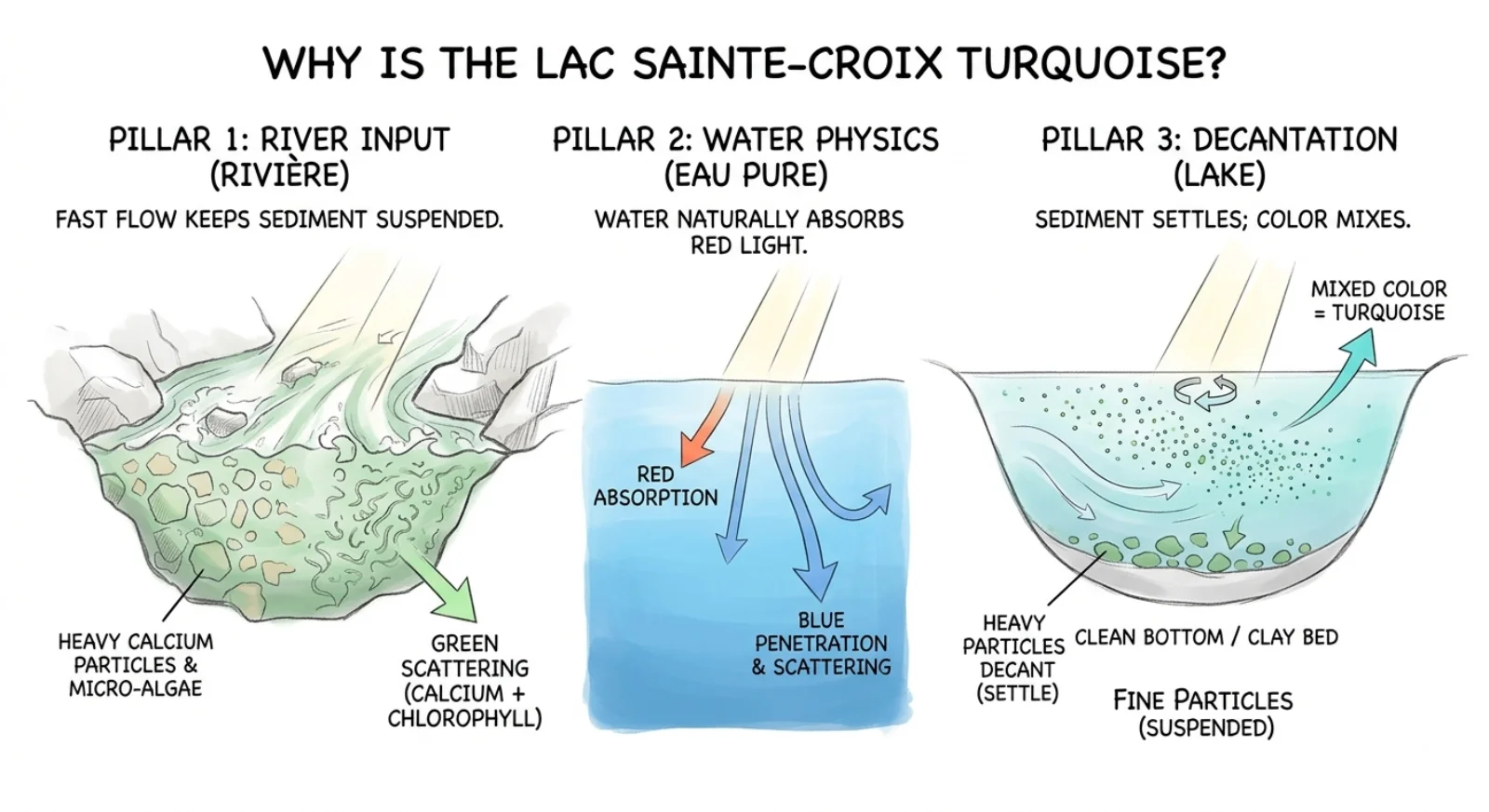
1. Pure water is already slightly blue. Water isn’t completely transparent: it has an intrinsic blue tint. Sunlight is a mix of every colour of the rainbow. When it enters water, H₂O molecules quickly absorb the red and yellow wavelengths (within a few metres). Blue travels much further before being scattered back to your eye. You can’t quite see it in a glass of water, but the moment you look at deep, very pure water, that blue jumps out.
2. The Verdon river is emerald green because of limestone and micro-algae. Coming down from the southern Alps, the Verdon carves an immense limestone canyon. The water tears at the rock and dissolves microscopic calcium carbonate particles that stay suspended in the current, and that scatter green light very effectively. In spring and summer, the Provençal sun also promotes microscopic algae (phytoplankton) whose chlorophyll bounces back green light. This cocktail is what gives the Verdon its characteristic emerald green. It’s also where its name comes from, the Latin viridis, “green.”
3. Lake Sainte-Croix turns turquoise because of settling. When the Verdon reaches the Sainte-Croix reservoir (filled in 1973), the water slows abruptly. The heaviest particles (silt, mud, coarse sand grains) fall to the bottom. What stays suspended near the surface is only ultra-fine calcium micro-particles, invisible to the naked eye one at a time, like a fine mineral dust. Too small to make the water cloudy, but just present enough to scatter green light that mixes with the natural blue of deep water. Green + blue = turquoise, without losing transparency.
On top of that, the lake bed is covered with pale marl and clay. That white-beige matter acts like the floor of a swimming pool: it bounces sunlight back to the surface and makes the colour even brighter. It’s the same signature you find in the other Verdon reservoir lakes: Chaudanne, Castillon, Quinson, Esparron, Montpezat.
The takeaway: same water at the start. In the river, the current keeps everything suspended, green dominates. In the lake, settling refines the particles and lets the natural blue take over. Turquoise.
The colour changes with the seasons
In winter and spring, when rain and snowmelt bring more particles, the water shifts to a more opaque green. In summer, with less runoff, it becomes clearer and bluer.
June, July and September are usually when the colour is at its densest and most photogenic.
What it means for swimming
The water is clean and healthy. Quality is monitored regularly, rated “excellent” most years. Visibility ranges from 3 to 8 metres depending on the area and the season.
The turquoise is strongest in deep water. From an electric boat, over 10 to 15 metres of depth, that’s where it comes into its full force.
For photos
Morning light (before 10 am) and evening light (after 5 pm) bring out the turquoise reflections. At noon, with the sun overhead, the water looks greener. Sunset from the heights above Bauduen, when the water holds green, blue and gold together at once, is the memory our guests tell us about most often.
The colour depending on your vantage point
The same water doesn’t look the same depending on the angle.
From the shore, the colour is intense but flat. In shallow water, you see the bottom, pale pebbles under transparent water. The turquoise is clean, almost unreal.
From an electric boat mid-lake, that’s where the effect is at its strongest. Beneath the hull, the water shifts as you move away from shore: pale blue-green at 3 metres, deep near-black blue by 15. At the mouth of the Gorges, where the cliffs close in, the colour goes between emerald and jade.
From the heights above Bauduen, the eye takes in 2,200 hectares at once. The shade changes by zone: paler where the bottom rises, denser in the middle. In fine weather, the surface reflects the sky and gives off its own blue light at the same time. From up there, the photos carry the furthest.
Is this phenomenon unique to France?
No, but it’s rare. Other turquoise lakes in France are mostly in the mountains: Alpine glacial lakes (Lake Brienz on the Swiss side, Lake Annecy to a lesser extent), where the same “glacial flour” gives similar colours. What sets Sainte-Croix apart is having this water at just 480 metres of altitude, in the middle of a landscape of scrubland and limestone. A Mediterranean setting, water you’d expect much further south.
What the colour says about swimming
Turquoise doesn’t mean cloudy. Here, the balance is perfect: just enough mineral micro-particles to give the colour, very little silt, mud or algae that would make the water opaque. It’s tied to the watershed: the Verdon crosses very lightly industrialised, lightly farmed areas before it arrives. Swimming quality is rated “excellent” almost every year.
In practice: no frequent skin allergies, no smell, bottom visible even in fairly deep water. With a mask on, you can see several metres down from the surface.
The water activities on the lake, electric boats, kayaks, paddleboards, benefit directly from this clarity: the bottom slides beneath your hull, fish pass by, algae move.