The Verdon Regional Nature Park is home to more than 180 bird species. Straddling the Alpes-de-Haute-Provence and the Var, its 188,000 hectares mix cliffs, limestone plateaus, forests, lakes and rivers — a spread of habitats that explains this richness. From Bauduen you’re on the edge of Lake Sainte-Croix, one of the observation points identified by LPO PACA on its ornithological map of the Park.
This guide is organised by habitat: the lake first (the easiest one to reach from the village), then the cliffs, the plateaus, and the forests. For each species: how to recognise it, its size, its behaviour, and when to see it. A pair of 8×42 binoculars is enough for almost all of these birds.
Birds of Lake Sainte-Croix
The lake and its shores are a two-minute walk from Bauduen. The first hours of the morning, low light and silence, are the most rewarding. Head for the quiet coves, on foot or by kayak.
Great crested grebe
 Great crested grebe, black crest and russet collar in breeding plumage. © Wikimedia Commons (CC BY-SA)
Recognise: elongated silhouette, thin straight neck, pointed bill. In breeding plumage (spring), a double black crest and a russet collar frame the white cheeks. Size: 46–51 cm, smaller than a mallard. Behaviour: dives for long stretches to fish, vanishes and reappears ten metres away. Its courtship display, both partners rising face to face out of the water, is one of the most astonishing spectacles in French ornithology. When: outside the high season, especially spring.
Great cormorant
Recognise: large black bird, thick neck, hooked bill. Often stands motionless on a rock, wings spread to dry (its plumage isn’t waterproof). In flight, neck stretched forward, slow wingbeats. Size: 77–94 cm, wingspan up to 1.5 m. Behaviour: diver, hunts fully submerged. When: all year.
Common moorhen
 Common moorhen, bright red bill with yellow tip, present all year. © Wikimedia Commons (CC BY-SA)
Recognise: small black silhouette, bright red bill with yellow tip, a thin white line along the flanks, green legs. Size: 27–31 cm. Behaviour: walks with a head-and-tail bob, swims through the reeds, runs over floating vegetation. Shy, stays near vegetated banks. When: all year.
Tufted duck
 Tufted duck, male with glossy black head and white flanks (a winter duck). © Wikimedia Commons (CC BY-SA)
Recognise: compact diving duck. Male black with striking white flanks and a small drooping tuft at the back of the head; bright yellow eye. Female dark brown. Size: 40–47 cm. Behaviour: dives to feed, in small groups. When: wintering, from November to March.
Little ringed plover and common sandpiper
Two waders of the pebbly shores. The little ringed plover (14–15 cm) is a small pale-beige bird with a black neck ring and a yellow ring around the eye; it nests on the gravel in May–June and runs in bursts. The common sandpiper (18–20 cm) is brown above, white below, and trots constantly while bobbing its rear body. You’ll meet them at the mouths of small coves.
Kingfisher
Recognise: impossible to mistake — electric turquoise-blue back, orange belly, long straight bill. Most often seen as a blue streak skimming the water. Size: 16–17 cm, the size of a chunky sparrow. Behaviour: watches from a low branch, dives head-first onto small fish. When: all year, along the edges of quiet coves.
Raptors and cliff birds
The walls of the Gorges are the great ornithological stage of the Verdon. Many can be seen with the naked eye from the Route des Crêtes and the viewpoints above La Palud-sur-Verdon (35 min from Bauduen).
Griffon vulture
Recognise: huge beige-russet raptor, very broad wings with “fingered” tips (feathers spread like fingers), pale head and bare neck. Size: wingspan up to 2.80 m. Behaviour: soars without flapping on thermals; the classic late-morning sight, a dozen birds spiralling upward in the same column of air. When: all year. LPO runs dedicated outings.
The cinereous vulture, rarer, is even larger and entirely dark brown, a more massive and more uniform silhouette than the griffon.
Peregrine falcon
 Peregrine falcon, barred underparts, black mask, nests on the cliffs. © Wikimedia Commons (CC BY-SA)
Recognise: compact and powerful raptor, slate-grey above, pale finely barred below, marked black “moustache” under the eye. Pointed wings. Size: 36–48 cm. Behaviour: fast, direct flight; stoops onto prey at more than 300 km/h, the fastest animal in the world. Nests on the canyon walls. When: March–April, from the higher viewpoints.
Golden eagle
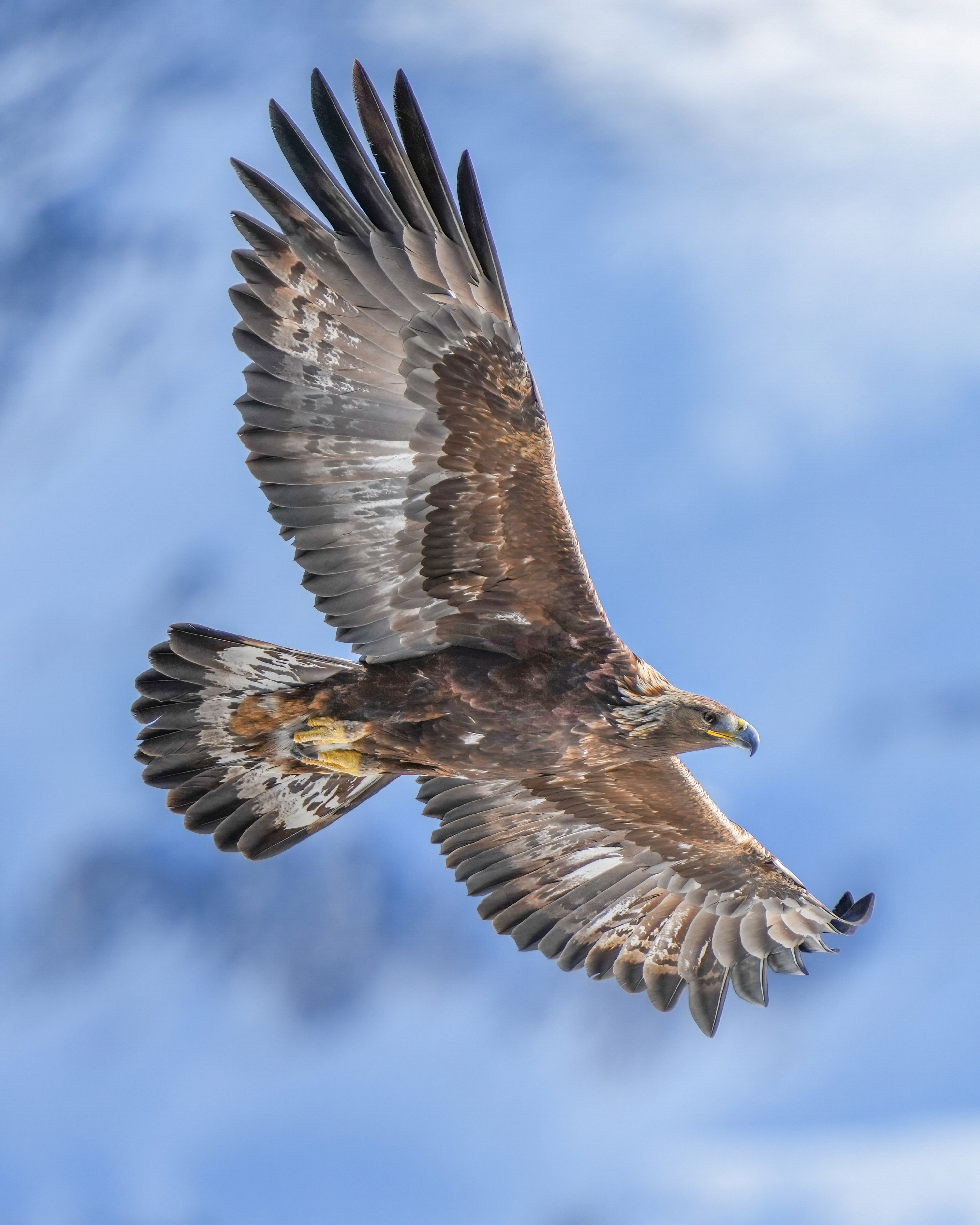 Golden eagle in flight, golden nape and long wings held in a shallow V. © Giles Laurent / Wikimedia Commons (CC BY-SA)
Recognise: large dark-brown raptor, golden nape visible close up, long wings held in a shallow V when soaring. Size: wingspan up to 2.20 m. Behaviour: vast territory, sightings uncommon but real, especially above the ridges between Rougon and Castellane. When: all year.
Common raven
Recognise: large all-black corvid, more massive than a crow, thick bill. In flight, diamond silhouette with a wedge-shaped tail. Size: 54–67 cm, wingspan ~1.20 m. Behaviour: deep rolling “krok-krok” call, aerial acrobatics. When: all year on the same cliffs.
Wallcreeper
 Wallcreeper, carmine-red wings opened butterfly-style. © Wikimedia Commons (CC BY-SA)
Recognise: small grey bird with a long, thin, curved bill, revealing large carmine-red patches on the wings in flight. Size: 16–17 cm. Behaviour: climbs vertically on the rock, wings fluttering like a butterfly. One of the hardest birds to spot in Europe. When: on damp cliffs, lower in altitude in winter.
Barn swallow
 Barn swallow, metallic-blue back, russet throat, long tail streamers. © Charles J. Sharp / Wikimedia Commons (CC BY-SA)
Recognise: metallic blue-black back, cream belly, russet throat and forehead, deeply forked tail with two long streamers. Size: 17–19 cm. Behaviour: chases insects on the wing, skimming low over fields and shorelines; nests under roof eaves and in barns. When: April to September (migratory, winters in Africa).
Plateau and heathland birds
The plateau de Valensole (40 min) and the open zones around Aups host species that have almost disappeared from intensive-farming France.
Eurasian hoopoe
 Eurasian hoopoe, orange fan-shaped crest, black-and-white striped wings. © Dejan Zakic / Wikimedia Commons (CC BY-SA)
Recognise: unmistakable. Orange-pink body, wings and tail broadly striped black and white, long orange crest with black tips that it fans open. Long, thin, curved bill. Size: 26–28 cm. Behaviour: walks on the ground, probes the earth with its bill; fluttering flight. Repeated “oop-oop-oop” call. When: April to September, along paths and in orchards between Bauduen and Aups.
European roller
 European roller, turquoise-blue with a cinnamon-brown back. © Wikimedia Commons (CC BY-SA)
Recognise: one of Europe’s most colourful birds — turquoise-blue head and belly, cinnamon-brown back. In flight, the wings reveal a deep, brilliant blue. Size: 29–32 cm, small-corvid build. Behaviour: watches from a post or a wire, drops onto large insects and lizards; nests in old hollow trees and dry-stone walls. When: May to August (migratory).
Little bustard
 Male little bustard, black-and-white collar during display. © Wikimedia Commons (CC BY-SA)
Recognise: stocky lowland bird, tawny mottled plumage. The displaying male shows a black neck barred with two white collars. Size: 40–45 cm. Behaviour: species in sharp national decline; the displaying male gives a dry “prrt” and jumps on the spot. Its presence here signals the quality of the territory. When: April–May, on the plateau de Valensole before the lavender blooms.
Stone-curlew
Recognise: looks like a large plover with beige streaked plumage, big yellow eye, yellow legs. Hard to see in daytime (motionless, camouflaged). Size: 38–45 cm. Behaviour: active at dusk and at night; its shrill, repeated call is one of the sounds of May nights in the garrigue. When: April to September, on stony plateaus. The rock bunting and the linnet share these same heaths.
Forest and mountain birds
Black woodpecker
 Black woodpecker, entirely black with a red crown. Europe’s largest woodpecker. © Wikimedia Commons (CC BY-SA)
Recognise: entirely black, the size of a crow, red crown (the whole crown in the male, only a patch at the back in the female). Size: 45–55 cm. Behaviour: drums powerfully; a piercing descending call often gives it away before you see it. Digs large oval cavities into beeches and Scots pines. When: all year, in high-altitude woodlands.
Short-toed snake eagle
Recognise: pale eagle, white below, broad dark head, flight punctuated by long hovers (“holy spirit hover”). Size: wingspan up to 1.80 m. Behaviour: specialised in hunting snakes; soars over forest edges. When: April to September (migratory).
White-throated dipper
Recognise: small dark-brown bird with a broad white bib, rounded silhouette, short cocked tail. Size: 17–20 cm. Behaviour: unique — walks underwater on the beds of streams to hunt its prey, against the current. It’s the emblematic bird of Verdon watercourses. When: all year, on the mountain streams that feed the lake.
High-mountain species
Above 1,700 m, in the Chiran and Mont Lachens area (1 h drive), you’ll come across the alpine chough (black corvid with a curved red bill and red legs), the black grouse (grouse of high heathland), and the wallcreeper in an alpine context. The common rock thrush and the blue rock thrush live on sunlit scree slopes.
When and where to watch
LPO identifies two ideal windows:
- March to June, the best period. Raptors in full nesting mode, migrants (roller, hoopoe, snake eagle) back, bustards displaying, vegetation not yet too dense.
- September to October, post-nuptial migration, many species passing through toward Africa, superb autumn light on the cliffs.
In July–August the birds are present but discreet, they sing little and hide in the shade during the hottest hours.
From Bauduen, in a single day you can watch water birds (the lake, 2 min on foot), cliff raptors (Route des Crêtes, 35 min) and plateau species (Valensole, 40 min). Few places in France offer this diversity from a single base.
A few rules: stay discreet, no dog, respect the marked paths, never approach nests during the reproduction season (March–June). To consult the precise distribution of each species in the region, LPO’s biodiversity atlas is online: biodivpaca-lpo.org/atlas.
Sources and credits: information from the discovery map “À la découverte des oiseaux du Verdon” and the itinerary “Les oiseaux d’eau des lacs”, published by LPO Provence-Alpes-Côte d’Azur (2024). Photos: Wikimedia Commons, CC BY-SA licences.
To plan your stay: activities on Lake Sainte-Croix · Verdon Gorges hikes for beginners · Verdon off-season: why it’s better.